System V
DEVELOPMENT TOPSHEET-EYES IN THE DARK
System V is a radical departure from my System-4. Many players have
really enjoyed System-4 for its generality, but working full time I do
not have time to spend the hours making characters and updating experience
as I'm sure you've all noticed! The fact is, I came to realize after
years of playtesting that the system I was using in my head to GM was far
simpler and more straigthforward than the system I had on paper, and I
said to myself "You're needlessly complicating things." Also, various comments
over the years from astute and adult gamers who couldn't fully comprehend
it told me I needed to simplify, so V is precisely that. V is built
on all the rigorous mathematics of 4 but simple, smooth and easy to play
and GM. It's an adult RPG system, adult in the sense of how much
time adults have to game.
System V is far from finished, but I've put together a minimal subset
to be able to test it out on I2D. It's premature, but I just
can't cope with -4 anymore.
Basic Rules
System-V is based basically on a system of dice. I like dice, so
although I cculd have gone diceless, I kept them in. In V, each attribute
or skill is based on a rating of 1D to 5D. The dice V uses
roll from 0-10, so if you have any old d20s, these will do nicely.
Mark one 10 as 0, the other as 10 and you're all set.
Dice rolls are a simple addition. If you want to jump a fence,
you make a roll for Agility. The GM says your rating is 2D, so you
roll two dice and add them up. Basic challenges, difficulties and
so on are based on the following tables.
| RATING |
Roll |
| 1D |
0-10 |
| 2D |
0-20 |
| 3D |
0-30 |
| 4D |
0-40 |
| 5D |
0-50 |
|
| Difficulty |
Task |
| 0 |
routine |
| 5 |
tricky |
| 10 |
difficult |
| 15 |
very hard |
| 20+ |
impossible |
|
| Margin |
Success |
| 0 |
barely |
| 5 |
partial |
| 10 |
adequate |
| 15 |
complete |
| 20 |
impressive |
| 25+ |
phenomenal |
|
Designing a Character
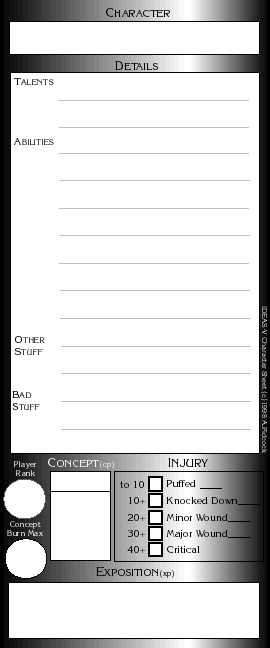 Characters
in V amount to words, not numbers. Take your
character-concept or what you have played so far and put your old 4 sheet
aside. I'm gonna get irate if I see [4] terms spewed back at me,
though not as irate as if I saw White Wolf terms. Print out
the following sheet, and print on it your char-description.
Characters
in V amount to words, not numbers. Take your
character-concept or what you have played so far and put your old 4 sheet
aside. I'm gonna get irate if I see [4] terms spewed back at me,
though not as irate as if I saw White Wolf terms. Print out
the following sheet, and print on it your char-description.
The way to do it is to split it up. There are no right or wrong
keywords to put on the sheet, though specific game terms from 4 are frowned
upon. Just keywords as long as we know what they mean will do.
Here are a couple of ways to organize your thoughts:
-
Write down a list of all the things you think of when you think of the
character and pick and organize the most important ones until you have
5-7.
-
Write a short paragraph describing your character in 2-3 sentences.
You should be able to pluck the main keywords out of that description.
Most characters are exceedingly simple when you come right down to it.
Examples:
-
Loopy is a new-age werewolf who was born and therefore thinks like a
wolf and is confused by human affairs. He is an empathic shape-shifter.
Keywords:
werewolf, wolf mind, empathic, shape-shifter.
-
Dexter is a boy genius with a secret lab, and an annoying sister. Keywords:
Boy Genius, Impatient, Annoying Sister.
-
Buffy is the slayer, the chosen one put upon the Earth to slay monsters,
but this time the chosen one is a valley girl. Keywords: Slays
Monsters, Valley Talk.
-
Scully is an FBI Agent and a medical doctor, and an incorrigible skeptic.
Keywords: FBI Agent, M.D.,Skeptic
Next, organize the keywords into categories. Talents, Powers,
Other Stuff, and Depth.
-
Talents: Natural qualities that set this person apart from others,
like "Brainy" or "Likeable" or "Cunning". Characters should have
1 or perhaps 2. They can be good and bad. Here are a list of
some sample talents:
Seductive, Writer, Agile, Cunning, Expert something, Martial
Artist.
-
Powers: Special abilities most folks can't have, like the power
to fly or change their shape. You needn't bother with the ability
to appear human, or regenerate, or great strength. All monsters have
these.
Shape Change, Camoflage, Venom, Storage, Illusion, Manifest, Dream
Walk, Fly, Serpentine, Fire Breath, Weresomething, Flatten, Telepathic,
Empathic, Density, Gravity Cannon, Necromancy, Source, Chill
-
Other Stuff: contacts, people, items, secret bases and other resources
go under other stuff. A character should have no more than 5-7 Powers
and Other Stuff.
Agent, Wealthy, Book of Spells, Magic Item.
-
Depth: Anything that potentially acts against a character down in
play but makes them more interesting. Limit to 1 or perhaps
2.
Innocent, Hunger for ... ,Undead,Anachronism,Unknown Origin
I'm available to advise on how to qualify your character.. If you don't
have a solid conception, I might.
Numbers
Alas, V has numbers! But not cp costs or skill levels. At the
bottom of your sheet you will see four boxes, Player Rating, Concept
Burn Max, Concept and Concept Max. Everybody starts with Concept
500 and concept Max 500. The exposition box leave blank, that fills
in during play, To know these numbers each player has to be rated
according to the following table:
| Rating |
Player-Type |
Concept
Burn Max |
Our Players |
| 1D |
Novice, GM' Girlfriend "Can I play?" |
25 |
Mikal,Toho |
| 2D |
Average gamer |
20 |
Skan, Janlop, Apollo |
| 3D |
experienced gamer |
15 |
Eg, Selene, Mordiken, Selenin, Janlop, Alex, Rak |
| 4D |
game designer, familiar with V |
10 |
|
| 5D |
pain in the ass powergamer, rules lawyer |
5 |
|
You're better off being at a lower rating, cause you get to burn more
concept. These are my guesses. Some of them may move around
during play or as you progress.
Combat
Combat in V is simple, too. You make a combat-skill roll and according
to how well you rolled you do a certain amount of damage based on your
damage-level. In H2H combat, your damage is determined by how strong
you are. How much damage you actually take is determined by your
body-type rating, too. These tables explain a bit more:
| Roll |
Damage
Level |
| 0-1 |
Miss |
| 2-9 |
Half |
| 10+ |
Normal |
| 20+ |
Double |
| 30+ |
x5 |
| 40+ |
x10 |
|
| wound |
|
effect |
|
10
|
|
Winded |
|
20
|
|
Out for a few turns |
|
30
|
|
Minor Wound; limp away |
|
40
|
|
Major Wound |
| 50 |
|
Critical |
|
| Strength |
Damage |
| Weak |
10 |
| Normal |
20 |
| Strong |
30 |
|
| Body-Type |
Rating |
| Puny |
1D |
| Average |
2D |
| Solid |
3D |
|
Here's an example. Let's say Franky who is Strong hits Talbain
who is Average. Franky rolls on 2D and rolls 8. So Franky does
HALF of 30 or 15. Talbain is Average, so his body-rating is
2D. 15 divided by 2D is 7, so Talbain is only Winded.
Effects
When your character uses abilities-- powers or skills-- they must get a
number of dice to roll for their action, and they pay concept for those
dice. The price of the ability is determined by its rating AND
how established this ability is for the character. Here are the
tables, filled out mainly to capture things that will occur in I2D:
| Ability: |
Rating |
| Mundane Skills; Contact |
1D |
| Useful Skills; Flight; Snare; Reach; Shrink; Telepathy; Empathy; Weapon;
Wealthy; Psychic; Life Support |
2D |
| Basic Attribution: Strength, Agility, etc.; Shape Change; Invisibility;
Venom; Storage; Illusion; Dream Walk; Blast; Ghostly; Density; Martial
Arts; Teleport; Mind Control |
3D |
| Another Form; Creation; Transformation; Regeneation; Immortality |
4D |
| Shape Shift; Summoning |
5D |
| Establishment |
Rating |
| Never used it before; first time |
5D |
| Used it before |
4D |
| In common use by the character |
3D |
| Well-established as part of the character |
2D |
| The character's always using this ability |
1D |
Example: Let's take the simple example where Eg is
trying to out-fly the angel Bendigo. She wants to roll 3D for her
aerobatics and he also wants to roll as much as he can. Each D of
Fly costs her 3 cp. (3D for "in common use") so its 9cp for 3D.
Depth:
Depth are things put on your sheet which are occasionally useful, interesting
to roleplay, and often make life difficult for your character, like enemies
or personality quirks. When you role-play a drawback, you get xp
according to how well-established this drawback is in your role-playing
style, and how inconvenient the drawback was to you, which depends a lot
on how you role-play it.
| Drawback |
Rating |
| A mild annoyance |
1D |
| inconvenient |
2D |
| Makes life difficult |
3D |
| Causes hazard |
4D |
| Crippling or actually damaging |
5D |
| Establishment |
Rating |
| Well-established and consistent |
5D |
| Commonly known |
4D |
| Known but sporadic |
3D |
| Has been seen before |
2D |
| First time it is seen |
1D |
I'm runnin out of cpteam.. What do I do now? (Concept and
Exposition)
You will be spending cp all the way through the game in order to do cool
stuff.. And as it keeps going down you might wonder.. when does it
go up? Throughout the game you will be awarded xp, for role-playing
drawbacks and for doing interesting scenes and things. Keep a running
total of the xp you are awarded. At the start of the next game, these
xp become new cp for you to playing with.
There are a number of rules around that:
-
All xp you scored at the end of last session become cp at the beginning
of the next session
-
If you are about to start with fewer cp than your Concept Max, reduce your
concept max by 1 and gain your Concept Max in cp.
-
If you are about to start with more than twice your concept max, you can
convert that many into one permanent concept (increasing your concept max.)
When you run out of concept, your character gets awful boring, so try not
to run out. If, however, it's a real interesting session and you've
been hogging the spotlight and want to continue to do so, you may ask your
GM to convert your xp now. He can do that, but it will mean you start
the next session with less.
Special Note: In our first session with V I won't be able to award
xp during play. You will receive a lump sum of xp after the session,
which to you all will seem identical to -4. It is, at first.
In future sessions you will be awarded things on the fly.
I2D Changes
While I'm at it, I want to reorganize our monster-mythos. But I'll
publish this page right away so you can get cracking, and finish up this
section later.